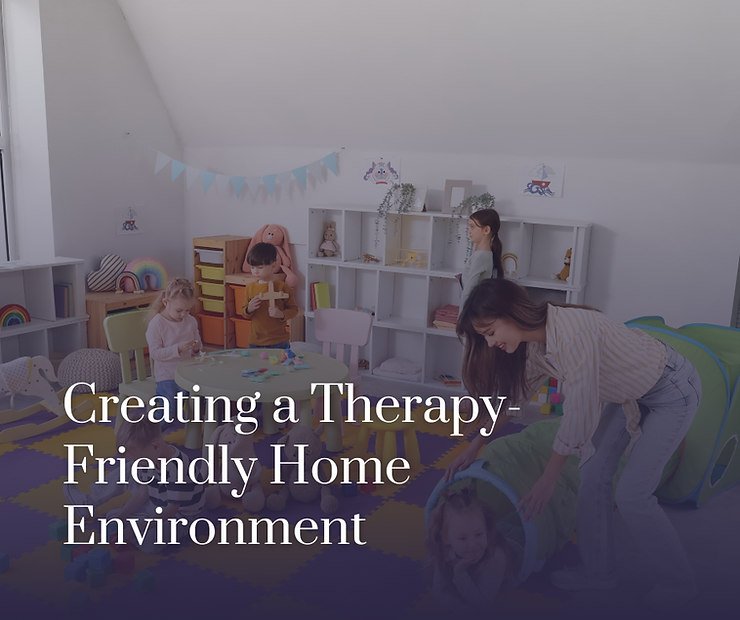
Your home is your child’s primary learning environment. Although your child may spend a majority of some days in other educational settings, their home is where most of the emotional development and generalization takes place. Even minor adjustments in the home environment can reduce the likelihood of interfering behaviors, increase independence, improve communication and transitions, and support emotional regulation.
The changes required to best support your child at home are simple and don’t require a full remodel. It’s about greeting a space that supports nervous system regulation, learning style, and developmental goals by creating opportunities for your child to exercise and strengthen their skills.
For a busy parent juggling therapy schedules, work, siblings, and everyday exhaustion, this guide is meant to focus on simple, realistic changes that actually help support your family at home.
What “Therapy-Friendly” Really Means
A therapy-friendly environment is one that:
Supports learning throughout the day
Reduces unnecessary stress and overstimulation
Encourages communication and independence
Makes routines predictable and visual
Allows skills learned in therapy to generalize into real life
You don’t need special equipment or expensive products. Your home doesn’t need to look like a clinic. You don’t need to run therapy all day.
Creating Calm, Regulated Spaces
A regulated nervous system supports learning, communication, and behavior. The providers at Essential Speech and ABA Therapy consistently coordinate care between speech therapy, applied behavior analysis, and occupational therapy.
Through this collaboration, we have determined these recommendations:
A. Reduce Visual and Auditory Clutter
Too many toys out at once increases overwhelm.
Use bins, shelves, and rotations.
Minimize background noise (TV, tablets, constant music).
B. Lighting and Sensory Considerations
Natural light when possible
Warm lighting instead of harsh overhead lights
Consider blackout curtains or lamps for sensitive kids
C. Designate a Calm/Regulation Area
Cozy corner, bean bag, tent, or quiet nook
Include:
Soft textures
Books
Sensory tools (fidgets, weighted items if approved)
Visual calm-down supports
You don’t need a whole room — even a small corner can become a powerful regulation space.
Organizing for Independence and Learning
Depending on your child’s skillset, it is important to set up the environment to promote opportunities for your child to strengthen and develop their skillset. For example, if your child is just learning to communicate their wants and needs, it is useful to give them the opportunity for ask.
Instead of providing your child with a large bowl of their favorite snack, you could give them a smaller portion to promote the opportunity for them to advocate for “more”. Here are some other ideas for promoting expansion:
A. Toy Organization Strategies
Clear bins with picture labels
Limit choices (3–5 options visible)
Rotate toys weekly or biweekly
B. Create Simple Learning Zones (Not Therapy Stations)
Table for crafts/homework
Floor play area
Reading nook
Outdoor movement space
C. Make Independence Easier
Step stools in bathroom/kitchen
Hooks at child height for backpacks/coats
Visual labels for drawers and shelves
Open shelving when possible
Visual Supports That Make Life Easier
Visual supports can be useful in that they reduce verbal overload (e.g., lengthy instructions), increase predictability, support transitions, and build independence.
Examples of useful visuals:
Daily schedules
Morning and bedtime routines
First/Then boards
Choice boards
Chore or clean-up charts
Emotion charts
Tips for success:
Keep visuals simple
Place them where the activity happens
Model using them consistently
Update as skills grow
Supporting Sensory Needs at Home
Everyone can benefit from integrated sensory opportunities at home, including adults and neuro-typical developing children. Here are some practical considerations to support these opportunities.
A. Movement Opportunities
Mini trampoline
Heavy work (pushing laundry basket, carrying groceries)
Outdoor play
B. Tactile and Proprioceptive Input
Play-Doh, sand, water play
Weighted blankets (as advised)
Deep pressure hugs (if child enjoys)
C. Sound and Texture Sensitivities
Noise-canceling headphones
Clothing considerations
Tag removal, softer fabrics
Building Predictable Routines Without Rigidity
Finally, routines can support nervous system regulation, promote predictability, reduce anxiety, increase compliance and cooperation, and improve transitions. Here are some considerations:
Key routines to prioritize:
Morning routine
Mealtime routine
Homework/play routine
Bedtime routine
Tips:
Visual schedules
Consistent order of steps
Allow flexibility for real life
Prepare for changes with warnings and visuals
Partnering with Your Therapy Team
In order to maximize support, it can be useful to coordinate care with your child’s therapy team by asking therapists what skills to practice at home, requesting visuals or modeling of skills presented in therapy, sharing what works and what doesn’t, and aligning routines with therapy goals.
Remember, as the parent, you are one of the most critical parts of the therapy team.